
The US Economy Is Very Strong
Yesterday, Darius joined Anthony Pompliano to discuss Consumer Spending, Personal Income, Inflation, and more.
In case you missed it, here are the three most important takeaways from the interview:
1. Consumer Spending Has Accelerated In Recent Months
Consumer spending, the total value of all goods and services purchased by households, makes up 68% of GDP.
Last week’s PCE report indicated that Real Personal Consumption Expenditures accelerated to 2.9% in June, primarily driven by a rebound in goods consumption – a three-month high.
In addition, Real Goods PCE accelerated to 5.4% on a three-month annualized basis, also a three-month high.
Both readings suggest US consumers remain incredibly resilient.
2) Accelerating Income Growth Supports Our “Resilient US Economy” Theme
Even if individual real wages are declining, as we have seen recently, overall consumer income can still grow from increased employment, government support, and other income sources.
Nominal Employee Compensation, the broadest nominal measure of income published about the labor market every month, accelerated to 6.2% three-month annualized in June – the highest reading since September last year.
Additionally, Personal Interest Income, the income individuals receive from interest-bearing assets like savings accounts and bonds, accelerated to 8.8% three-month annualized basis in June.
This figure is the highest number we have seen since January of this year and signals that consumers may have more disposable income to spend.
3) The Inflation Fight Is Improving Significantly
Typically, inflation breaks down AFTER a recession. This year, we have seen the opposite – a term referred to as “immaculate disinflation”.
In Friday’s PCE report:
- Core PCE, the Fed’s preferred measure of inflation, decelerated to 3.3% on a three-month annualized basis, the lowest print since February 2021.
- Super Core PCE decelerated to 3.2% on a three-month annualized basis, the lowest print since July 2022.
- Median PCE decelerated to 3.8% on a three-month annualized basis, the lowest print since August 2021.
- Trim Mean PCE decelerated to 3.4% on a three-month annualized basis, the lowest print since August 2021.
We expect the YoY inflation numbers to follow the low three-month annualized rates over the coming months, strengthening the immaculate disinflation narrative supporting asset markets.
That’s a wrap!
If you found this blog post helpful:
- Go to www.42macro.com to unlock actionable, hedge-fund caliber investment insights.
- RT this thread and follow @42Macro and @42MacroWeather.
- Have a great day!
Is the Fed Done Hiking?
Earlier this week, Darius joined Maggie Lake and Andreas Steno on Real Vision to discuss the Fed, Inflation, and more.
If you missed the interview, we have you covered. Here are three key insights that will save your portfolio:
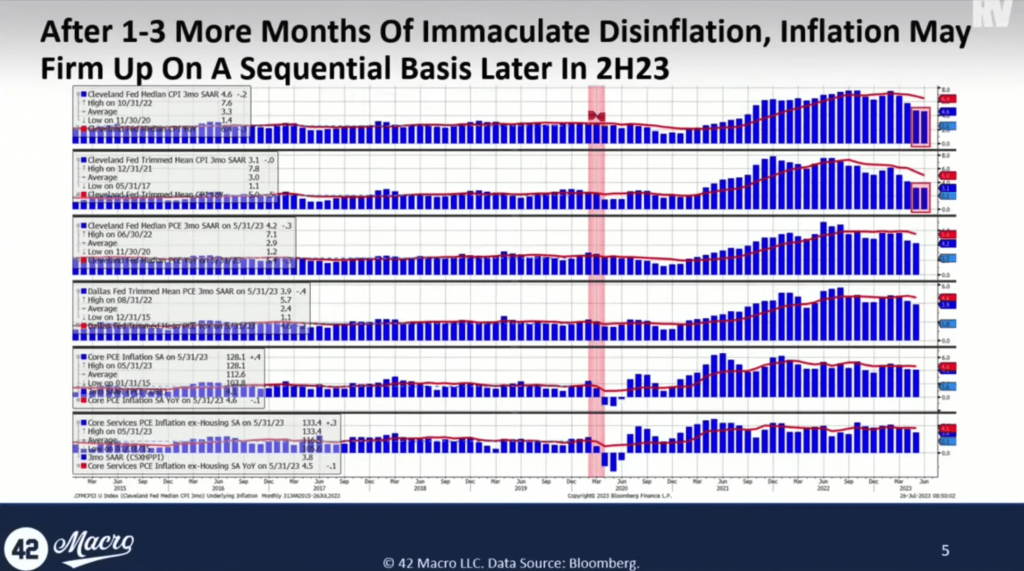
1) We Believe The Narrative Surrounding Inflation Will Change In 3-6 Months
The interplay between immaculate disinflation and rising soft landing expectations has been the driver behind asset markets this year.
We believe any potential shifts in this narrative are not being adequately priced into market forecasts.
Reviewing several key inflation measures—median CPI, trim mean CPI, median PCE deflator, trim mean PCE, core PCE, and super core PCE—highlights a concerning trend. Sequential trends, especially for median CPI and trim mean CPI, indicate stagnation between 3% to 4%. If this lack of progress continues, it could be problematic for the economy.
Our models indicate that a recession in the US economy is unlikely to begin until Q4 this year or Q1 next year, with the depths of the recession probably not hitting until the second or third quarter of next year.
2) The Rate of Change of Inflation Is Important, Not the Level
Investors should be concerned with inflation’s direction and velocity – not the current level.
Why? Because the rate of change is what markets react to. While the Federal Reserve may concern itself with the actual level of inflation, investors should strive to be one step ahead of the Fed, analyzing shifts in the direction and speed of travel.
3) A Soft Landing In Growth = A Soft Landing In Inflation
Inflationary impulses in the economy take time to permeate fully – this explains why the BLS and BEA measure inflation as they do.
Inflation has subsided back to around 2% when you exclude the lagging housing components of inflation.
Notably, core services ex-housing CPI and the core services ex-housing PCE deflator are showing three-month annualized rates of 1.4% and 3.2%, respectively.
If we do have a soft landing, it will likely be at some point in 1H24 — a scenario that, while not the most probable, is far more likely than a near-term recession.
Under these conditions, we believe we would see metrics like super core CPI, super core PCE, and core PCE firm up and begin accelerating again.
That’s a wrap!
If you found this thread helpful, go to www.42macro.com/macro-bundle to unlock actionable, hedge-fund caliber investment insights and have a great day!
Is Wall Street Calling The Fed’s Bluff?
Earlier this week, Darius joined Anthony Pompliano to discuss Manufacturing, the U.S. Consumer, Bitcoin, and more.
Miss the discussion? No problem. Here are the three most important insights that can help your portfolio:
1) Healthy Balance Sheets And A Robust Labor Market Are Contributing to a Resilient U.S. Consumer
Since August of 2022, we have consistently maintained the view that the U.S. economy would remain robust, despite recession fears.
June’s retail sales reported a 4.6% increase on a three-month annualized basis and the highest print we have seen in four months – further proof of the resilience of the consumer we have consistently called for.
Additionally, a significant driver of the increase in retail sales, auto sales, accelerated by a striking 23% on a three-month annualized basis.
Two key contributors to this consumer resilience have been healthy consumer balance sheets and a strong labor market.
2) Leading Manufacturing Indicators Point to Near-Term Bottom in the Inventory Cycle
The ISM Manufacturing PMI, the most widely used leading indicator for the broader US manufacturing cycle, recently dropped to 46.0 in June – a new cycle low.
However, the spread between the ISM Manufacturing New Orders PMI and ISM Manufacturing Inventories, which is a leading indicator of the headline index, suggests a bounce in the ISM Manufacturing PMI in the coming months.
A recovery in the inventory cycle would add additional support to the soft landing narrative and incrementally contribute to the epic short squeeze in US equities that we have and continue to call for.
3) S&P 500 and Bitcoin Correlations:
As part of our 42 Macro research, we conduct a multi-factor correlation study, tracking the S&P 500 and Bitcoin in relation to various macro factors.
Recently, the primary driver of the S&P’s performance has been cyclical growth expectations.
Bitcoin, however, is being driven by structural growth expectations, but inversely, and is rallying on potential recession prospects, which would pressure the Fed and other central banks to provide the market with ample liquidity.
Although most investors bundle risk assets into one broader bucket, the reality is that there is often a divergence between what drives different asset markets.
We believe the Fed will begin providing liquidity to the market by the spring of next year, creating a positive environment for risk assets into and through the end of 2024.
That’s a wrap!
If you found this thread helpful, go to www.42macro.com/macro-bundle to unlock actionable, hedge-fund caliber investment insights and have a great day!