
Dale: U.S. Growth Slowing Due To Policy Uncertainty
Darius Dale, Founder & CEO of 42 Macro, recently joined Nicole Petallides on Schwab Network to break down market volatility, the resilience of the U.S. economy, and how investors should be thinking about liquidity, policy uncertainty, and positioning. In case you missed the appearance, here are three key takeaways that could shape your portfolio strategy:
1) Liquidity is Likely To Rescue Markets
Despite concerns over short-term volatility, Darius sees a general uptrend in asset markets driven by accelerating liquidity—both globally and within the U.S. As the Treasury General Account (TGA) declines and net debt issuance is restrained, liquidity conditions should remain supportive for risk assets. With the Fed likely ending the Treasury portion of its balance sheet runoff in the next one to two quarters, markets could see even more relief from liquidity tailwinds.
2) Policy Uncertainty Is Slowing Growth, But Not Breaking the Economy
While corporate confidence remains high due to expectations of business-friendly policies, the data shows a real slowdown in U.S. economic growth. Elevated policy uncertainty—at levels seen only during the Global Financial Crisis and the COVID-19 pandemic—is causing businesses and consumers to hesitate on investment decisions. However, Darius does not see this leading to a recession but warns that prolonged uncertainty could trigger renewed hard-landing fears that weigh on markets.
3) Clarity On Bad Policies + Uncertainty Regarding Good Policies = Risk Assets Struggle
Darius revisits his Triple S Framework—Size, Sequence, and Scope—to assess Trump’s potential economic policies, again, emphasizing that sequence is the critical risk factor. If restrictive measures like tariffs and immigration control are implemented first, they could tighten the labor market, drive up wages, and fuel inflationary pressures. Conversely, if pro-growth policies such as tax cuts and deregulation come later, they may help offset these effects. Ultimately, the market’s reaction will depend on the order in which these policies unfold.
Final Thought: Risk On For Now, But Stay Nimble
Despite policy-driven risks, the current market regime remains risk-on, favoring a buy-the-dip strategy in higher beta and cyclical assets. Emerging markets and international equities have outperformed recently, and relative economic trends suggest that outperformance could continue. But with historic policy uncertainty clouding the road ahead, investors should remain adaptable.
If you are not confident your portfolio is positioned correctly for the evolving macro landscape , partner with 42 Macro’s data-driven insights and risk management processes to help you stay on the right side of market risk.
THE MACRO CLASS
No catch—just real insights to help you stay ahead in the #Team42 community.
Best of luck out there,
— Team 42
Is The Fed Fighting A Losing Battle Against Inflation?
Darius recently joined Charles Payne on Fox Business to discuss why the Fed’s inflation fight is failing, the limits of traditional economic indicators, and how Trump’s potential policies could impact markets. If you missed the appearance, Here are three key takeaways that could significantly impact your portfolio:
1) The Fed’s 2% Inflation Target is Unattainable
Darius has been warning since January 2022 that the U.S. economy’s equilibrium inflation rate is in the high 2% to low 3% range, making the Fed’s 2% target unrealistic. Despite recent disinflationary trends, inflation remains sticky, and the latest data reinforces the idea that the Fed won’t get back to 2% without causing serious economic damage. Rather than continuing its restrictive policy, the Fed should revise its target higher and adjust accordingly.
2) Traditional Economic Indicators Are Outdated
Darius argues that widely used indicators like the Leading Economic Index (LEI) are outdated and less relevant in today’s economy. Decades ago, manufacturing made up 30% of GDP and 50% of employment—today, it is only 10% of GDP and 14% of jobs. This structural shift means that many recession indicators don’t capture the strength of the modern economy, which remains resilient due to fiscal stimulus and liquidity dynamics.
3) Trump’s Policy Agenda Could Trigger Inflationary or Deflationary Shocks—Depending on Its Sequence
Darius outlines his Triple S framework—Size, Sequence, and Scope—to evaluate Trump’s potential economic policies. The biggest risk? Sequence. If tariffs and immigration restrictions are implemented first, they could disrupt supply chains, tighten the labor market, and push inflation higher before pro-growth policies like tax cuts and deregulation take effect. The market impact depends on how these policies are rolled out and whether the positives outweigh the negatives.
Final Thought:
Liquidity is likely to trend higher through mid-2025, which is supportive for asset markets. That said, policy-driven inflation risks and potential Fed missteps remain key threats. Investors would be remiss to rely exclusively on fundamental predictions amid a historically wide distribution of probable economic and policy outcomes.
If your risk management signals are not keeping you on the right side of market risk, parter with 42 Macro and join the thousands of investors benefiting from our KISS Model Portfolio and our Discretionary Risk Management Overlay, also know as “Dr. Mo”.
THE MACRO CLASS
No catch—just real insights to help you stay ahead in the #Team42 community.
Best of luck out there,
— Team 42
How Will Trumponomics 2.0 Impact Investor Portfolios?
Darius recently joined Charles Payne on Fox Business to discuss the potential impact of President Trump’s economic agenda on asset markets, the importance of observing the market rather than predicting it, and more.
If you missed the interview, here are the three most important takeaways fromthe conversation that have implications for your portfolio:
1) How Will President Trump’s Economic Policies Broadly Impact Markets in 2025?
When assessing the impact of President Trump’s economic agenda, both positive and negative effects on the economy and asset markets are likely.
Specifically, factors such as tariffs, securing the border, and a hawkish shift in Treasury net financing (i.e., less bills + more coupons) are likely to contribute negative supply shocks to the economy and asset markets. Conversely, tax cuts, deregulation, and accelerated energy production could generate positive supply shocks.
Investors should closely monitor the size, sequence, and scope of these policy changes, as they will play a crucial role in shaping asset markets throughout 2025.
2) What is The Likely Impact of Tariffs on Asset Markets?
Although many Wall Street investors cite the Smoot-Hawley example when discussing tariffs, we believe anchoring on that scenario is misguided. The real impact lies in the currency market. China is likely to respond to fresh tariffs by significantly devaluing the yuan, which carries profound implications for global asset markets. Historically, when China devalues the yuan, other major economies follow suit with sympathy devaluations to maintain competitiveness, resulting in a much stronger U.S. dollar.
If a similar pattern emerges in 2025, this would likely lead to a reduction in global liquidity, which is problematic for asset markets in the context of the global refinancing air pocket that may develop later this year.
3) Should Investors Focus On Observing The Market Rather Than Predicting It?
In short, yes. Our number one piece of advice for every investor is: Listen to what the market is telling you. Because asset markets trend far more frequently than they experience changes in trend, it is always best to align your portfolio with what the market is trying to price in, not against it. The trend is your friend.
Whether we are in an inflationary or deflationary environment, the most consistently successful strategy across all market conditions is trend following.
To successfully remain on the right side of market risk, investors must rely on signals from proven risk management systems (e.g., KISS and Dr. Mo) far more than their gut feel, emotions, or understanding of company or economy fundamentals.
Since our bullish pivot in January 2023, the QQQs have surged 81% and Bitcoin is up +328%.
If you have fallen victim to bear porn and missed part—or all—of this rally, it is time to explore how our KISS Model Portfolio or Discretionary Risk Management Overlay aka “Dr. Mo” will keep your portfolio on the right side of market risk going forward.
Thousands of investors around the world confidently make smarter investment decisions using our clear, accurate, and affordable signals—and as a result, they make more money.
If you are ready to learn more about how our clients incorporate macro into their investment process and how you can do the same, we invite you to watch our complimentary 3-part macro masterclass.
No catch, just macro insights to help you grow your portfolio—our way of saying thanks for being part of our global #Team42 community of thoughtful investors.
Best of luck out there,
— Team 42
What Must Be Done To Prevent DOGE From Failing?
Darius recently sat down with FFTT Founder and President Luke Gromen to discuss how marketable U.S. treasury market dynamics have shifted over recent years, the likelihood of a meaningful reduction in the federal budget deficit in this Fourth Turning, and more.
If you missed the interview, here are the two most important takeaways from the conversation that have significant implications for your portfolio:
1. How Have Changes In Ownership Structure Contributed To Price And Yield Dynamics In The Treasury Market?
At 42 Macro, one of the ways we analyze the marketable U.S. Treasury market is by segmenting it into various investor cohorts:
- The Federal Reserve: The Fed’s share has been declining due to balance sheet runoff, peaking at 25% in late 2021 and now at only 15% of total marketable Treasury securities.
- Commercial Banks: Banks’ market share decreased from early 2022 until late 2023, when it began to stabilize. This stabilization was driven by programs like the Bank Term Funding Program (BTFP) and expectations that the Federal Reserve would dramatically lower interest rates. Currently, their share is around 15%, well south of the peak of 33% in 2003.
- Foreign Central Banks: The decline in global trade and the steady shift away from global dollar recycling led by the BRICS member nations caused foreign central banks’ share to steadily decline to 14% from a peak of 40% during the 2008 global financial crisis.
- Global Private Non-Bank Sector (Investors): This cohort has become the largest holder of marketable U.S. Treasury securities, with its share increasing from 36% in late 2021 to 55% today.
This shift in ownership has structurally altered the Treasury market. Unlike banks—such as the Fed, foreign central banks, and commercial banks which purchase Treasurys to satisfy policy or regulatory mandates (e.g., Dodd Frank, Basel III and IV)—global investors demand ex ante returns to compensate for taking risk in their portfolios.
As a result of this seismic shift, upward pressure on yields has intensified, signaling a more acute phase in the evolution of Treasury market dynamics and expectations.
2. How Likely Is Significant Reduction In The Federal Budget Deficit During This Fourth Turning?
Our analysis of U.S. federal budget dynamics highlights significant challenges to achieving meaningful deficit reduction.
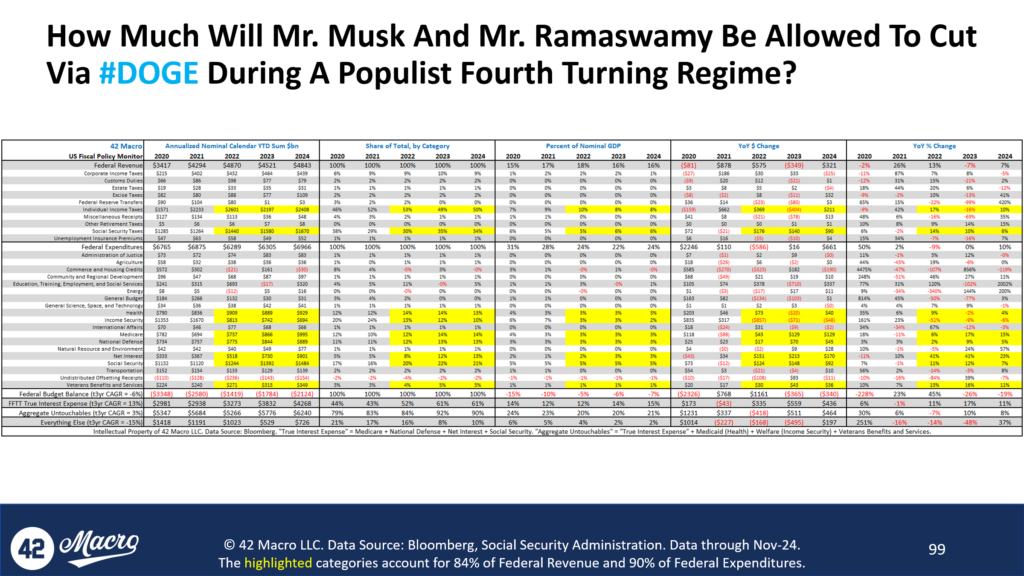
First, U.S. federal expenditures currently represent roughly a quarter of U.S. GDP—the highest share since at least 1970 excluding COVID and the GFC. Thus, significant cuts would likely catalyze a downturn in the economy—however beneficial a smaller government would be in the long run, which is something both Darius and Luke agree with. Per Luke, the last three recessions saw the U.S. federal budget deficit widen by 600bps, 800bps, and 1,200bps.
Secondly, our research indicates that approximately 90% of the budget is effectively untouchable. This “Aggregated Untouchables” category includes “True Interest Expense”—comprising Medicare, National Defense, Net Interest, and Social Security—along with Medicaid, Welfare, and Veterans’ Benefits. Collectively, these expenditures represent programs unlikely to face cuts under the current pro-populist political climate and are compounding at a rate of +3% per year (+13% per year in the “True Interest Expense” category). The remaining 10% of the budget, which largely includes discretionary spending, amounts to just over $700 billion and has already been shrinking at a compound rate of -15% per year over the past three years.
Lastly, demographic trends are exacerbating the fiscal burden. By 2025, 160,000 people will join the retirement-age population each month, compared to just 32,000 entering the working-age population.
Given these dynamics, meaningful deficit reduction appears improbable without tackling politically protected categories. This leads us to believe that meaningful austerity is an unlikely path forward in the context of this current Fourth Turning environment—especially without a significant devaluation of the US dollar preceding it.
Since our bullish pivot in November 2023, the QQQs have surged 42% and Bitcoin is up +190%.
If you have fallen victim to bear porn and missed part—or all—of this rally, it is time to explore how our KISS Model Portfolio or Discretionary Risk Management Overlay aka “Dr. Mo” will keep your portfolio on the right side of market risk going forward.
Thousands of investors around the world confidently make smarter investment decisions using our clear, accurate, and affordable signals—and as a result, they make more money.
If you are ready to learn more about how our clients incorporate macro into their investment process and how you can do the same, we invite you to watch our complimentary 3-part macro masterclass.
No catch, just high-quality insights to help you grow your portfolio—our way of saying thanks for being part of our global #Team42 community of thoughtful investors.
Is The Fed On The Precipice Of Another Major Policy Mistake?
Darius recently hosted Unlimited Funds CEO Bob Elliot on this month’s 42 Macro Pro to Pro, where they unpacked the Fed’s asymmetrically dovish reaction function, the impact of the work-from-home phenomenon, their systematic approaches to investing, and more.
If you missed the interview, here are the three most important takeaways from the conversation that have significant implications for your portfolio:
1. What Is Driving the Fed’s Expansionary Monetary Policy?
We authored our “Resilient U.S. Economy” theme in September 2022, and since then, we have identified a new contributing pillar: the continuation of expansionary monetary policy.
We believe this policy direction is puzzling, driven largely by the Fed’s belief that no further cooling in the labor market is needed to achieve 2% inflation—a stance we view as highly likely to be inaccurate. Nevertheless, it remains the Fed’s current perspective.
Bob Elliot offered an insightful take on this issue, suggesting that the Fed’s position likely stems from a fundamental disconnect between how academics interpret markets and models versus how practitioners do. This divergence may explain their controversial outlook on the labor market’s role in achieving their desired inflation target.
2. How Is The Work-From-Home Phenomenon Affecting Labor Market Dynamics?
At 42 Macro, we monitor various workforce dynamics metrics, including Nonfarm Productivity Growth and the Private Sector Quits Rate. Our analysis shows that Productivity Growth is currently above trend, while the Private-Sector Quits Rate has declined significantly from its elevated levels over the past couple of years.
We believe this shift toward longer employee tenures is likely a key driver behind the current above-trend rate of productivity growth, as longer retention generally leads to greater employee efficiency. This increased productivity is helping to offset some of the inflationary pressures stemming from higher wages and income growth, and we believe it is likely to persist.
Additionally, the rise of remote work plays a significant role in this dynamic. With the flexibility to live and work from virtually anywhere, employees are more likely to stay with their current employers, further contributing to lower turnover and increased productivity.
3. Why Did We Replace Core Fixed-Income Exposure with Gold in Our KISS Portfolio?
One of the recent adjustments we made in our systematic KISS Model Portfolio was to replace our core fixed-income exposure with gold. This decision reflects our understanding that if our Investing During A Fourth Turning Regime analysis proves true over the long term, it is highly unlikely that bonds will outperform other assets on a real, risk-adjusted basis.
While we recognize that no one—including us—is ever 100% correct on their fundamental views, even partial accuracy in our predictions suggests a strong likelihood that assets like gold, Bitcoin, stocks, and real estate will prove to be far better hedges against accelerated monetary debasement and financial repression than bonds. Indeed, we expect monetary debasement and financial repression to be tools that the Fed employs to address the challenges of excessive sovereign debt and a robust economy that leaves little incentive for buyers of government bonds.
Given this dynamic, we pivoted entirely out of core fixed-income exposure and allocated that portion of our systematic KISS Model Portfolio to gold in October. Our 60/30/10 trend-following strategy now features maximum allocations of 60% stocks, 30% gold, and 10% Bitcoin.
Since our bullish pivot in November 2023, the QQQs have surged 37%. Momentum $MTUM is up +48% and Bitcoin is up +169%.
If you have fallen victim to bear porn and missed part—or all—of this rally, it’s time to explore how our KISS Model Portfolio or Discretionary Risk Management Overlay aka “Dr. Mo” will keep your portfolio on the right side of market risk going forward.
Thousands of investors around the world confidently make smarter investment decisions using our clear, accurate, and affordable signals—and as a result, they make more money.
If you are ready to learn more about how our clients incorporate macro into their investment process and how you can do the same, we invite you to watch our complimentary 3-part macro masterclass.
No catch, just macro insights to help you grow your portfolio—our way of saying thanks for being part of our global #Team42 community of thoughtful investors.
Financial Repression Survival Tactics
Darius recently sat down with Exploring Prosperity’s Robert Dewey, where they discussed the new wave of populism, the impacts of the U.S. regional banking crisis, the U.S. dollar, and more.
If you missed the interview, here are the three most important takeaways from the conversation that have significant implications for your portfolio:
1. Is There A Material Difference Between Either Presidential Candidate From A Fiscal Policy Perspective?
Regardless of which candidate wins the upcoming election, we believe we are likely to see even more populism, or the promotion of policies that reflect the concerns of the people, regardless of the economic or institutional impact those policies have.
No matter what form this new wave of populism takes, it is likely to drive US public sector debt growth that forces the Fed to remain asymmetrically dovish.
Our view is that we are all frogs being slowly boiled alive in a pot of monetary debasement and financial repression, driven by Fourth Turning-style fiscal dominance. We have called for continued financial repression, which we have already experienced—and in our view, it is likely to accelerate throughout this Fourth Turning.
2. How Has The Focus of Policymakers Shifted Since The U.S. Regional Banking Crisis?
During the U.S. regional banking crisis in March 2023, the forward rate curve inverted and has remained persistently negative ever since.
This deepening inversion signaled to investors that financial stability concerns had taken precedence—reflecting Fourth Turning-style financial repression, in which stabilizing sovereign debt markets is the central focus for policymakers.
The persistent inversion has profoundly impacted the Fed’s balance sheet and overall U.S. liquidity. As the Fed responded with dovish measures during the crisis, trillions of dollars flowed out of the reverse repo (RRP) facility and into financial markets. In our view, this liquidity flow remains ongoing and is likely to extend into Q1 2025.
3. How Will Global Reliance on The US Dollar Change Over The Next Decade?
Our research indicates the U.S. dollar currently plays a dominant role in the global financial system:
- 50% of currencies with pegs are anchored to the dollar (by GDP).
- 60% of global FX reserves are held in dollars.
- 60% of cross-border bank lending is conducted in dollars.
- 70% of international debt securities are dollar-denominated.
- 79% of global trade is invoiced in dollars.
- 88% of foreign exchange transactions involve the dollar.
- 99% of stablecoin reserves are backed by the dollar.
In our view, these numbers will decline over the long term as countries reduce their reliance on the dollar. We believe the continuation of aggressive populist fiscal policies in the U.S. poses significant risks for investors, with the most important risk being how the Federal Reserve responds to the global shift away from the dollar, as this transition will have profound implications for financial markets. We think the Fed will print money to monetize US deficits, filling the increasing void left behind by international investors and central banks.
By now, you’ve likely realized that piecing together an investment strategy from finance podcasts, YouTube videos, and macro “gurus” on 𝕏 is not delivering the results you know you deserve.
This kind of approach only leads to confusion from conflicting advice, frustration from mediocre returns, and exhaustion from the emotional rollercoaster of your portfolio swings.
If you don’t change your process, how can you expect to get better results?
Over 2,000 investors around the world confidently make smarter investment decisions using our clear, actionable, and accurate signals—and as a result, they make more money.
If you are ready to learn more about how our clients incorporate macro into their investment process and how you can do the same, we invite you to watch our complimentary 3-part macro masterclass.
No catch, just macro insights to help you grow your portfolio—our way of saying thanks for being part of the 42 Macro universe.
Navigating Inflation, Budget Deficits, and Global Monetary Shifts
Darius recently hosted our friend Nadine Terman on 42 Macro’s Pro to Pro, where they discussed inflation, the federal budget deficit, China, and more.
If you missed the interview, here are the three most important takeaways from the conversation that have significant implications for your portfolio:
1. Are Both Political Parties Likely to Increase The Federal Budget Deficit?
Even if Republicans win and Elon Musk advocates for severe spending cuts, we believe those cuts are unlikely to materialize. While there may be headlines about cutting spending, slashing large portions of the budget carries significant career risk.
Our research shows that the type of wasteful spending Musk might target accounts for less than 1% of federal expenditures. Meaningful cuts would require reductions in defense, Medicare, or Medicaid—areas deeply important to American voters.
Some minor budget trims may occur, but both parties appear committed to profligate spending, with no clear plan to meaningfully reduce the national debt.
2. How Has The Recent Shift In U.S. Monetary Policy Affected Chinese Policymakers?
At 42 Macro, we monitor the growth of the PBOC’s balance sheet relative to the share allocated to FX reserves. When the yuan appreciated sharply in early 2015, its real effective exchange rate (REER) rose significantly, disrupting China’s export model.
As the Yuan became expensive on a REER basis, export growth secularly slowed and foreign direct investment into China slowed, reducing the expansion of its manufacturing base. As a result, the share of FX reserves declined from approximately 83% to just 50% since March 2014.
However, the recent shift to a more neutral U.S. monetary policy, evidenced by the Fed’s decision to implement a 50-basis-point rate cut, suggests less risk of severe yuan devaluation. This change has signaled to Chinese policymakers that they can now begin accelerating monetary expansion.
By now, you’ve likely realized that piecing together an investment strategy from finance podcasts, YouTube videos, and macro “gurus” on 𝕏 is not delivering the results you know you deserve.
This kind of approach only leads to confusion from conflicting advice, frustration from mediocre returns, and exhaustion from the emotional rollercoaster of your portfolio swings.
If you don’t change your process, how can you expect to get better results?
Over 2,000 investors around the world confidently make smarter investment decisions using our clear, actionable, and accurate signals—and as a result, they make more money.
If you are ready to learn more about how our clients incorporate macro into their investment process and how you can do the same, we invite you to watch our complimentary 3-part macro masterclass.
No catch, just macro insights to help you grow your portfolio—our way of saying thanks for being part of the 42 Macro universe.
The Biggest Threat To The US Economy Today
Darius recently joined our friend Anthony Pompliano, where they discussed the impact of the recent port strike, the outlook for inflation, the national debt, and more.
If you missed the interview, here are the three most important takeaways from the conversation that have significant implications for your portfolio:
1. What Impact Will The Recent Port Strike Have On The Economy?
Many of the goods entering the country pass through the ports along the Gulf Coast, East Coast, and the Port of Long Beach. We believe the recent shutdowns at these ports are likely to cause a temporary stagflationary effect.
To track the potential impact on inflation, we monitor the ISM Manufacturing and Services PMIs, which include a subindex for slower supplier delivery times. Our research shows these delivery times surged during the pandemic and after the early 2021 Biden stimulus, but have since retreated, coinciding with a decline in core inflation.
However, with the port shutdowns – now scheduled to begin on January 15th – we expect delivery times to rise again, further contributing to the stickiness in inflation we are currently observing.
2. Is 3% Inflation The New 2%?
We first published our secular inflation model at the beginning of 2022, which predicts a higher underlying trend in core PCE inflation over the next decade.
From 2010 to 2019, the 10-year run rate of core PCE inflation was 1.6%. However, our model projects a range of 2.7% to 3.1% for 2020 to 2029.
We have maintained the view that the Federal Reserve is prioritizing financial and economic stability over strict adherence to its 2% inflation target. Inflation has effectively become the Fed’s third mandate, and we believe the Fed will ultimately tolerate a higher trend inflation rate over the next decade, likely around 3%, even if they do not officially adjust their target.
3. Do Both Political Parties Contribute To The Deficit?
Our deep dive into historical economic and policy dynamics reveals that both Republicans and Democrats have contributed to the national debt.
Since the post-war era, the growth rate of the national debt under both administrations has been roughly similar:
- After one year, median cumulative debt growth is 7% under Democrat Presidents and 6% under Republican Presidents.
- After two years, it is 10% for Democrats and 12% for Republicans.
- By the third year, both are around 22%.
- By the fourth year, Republicans outpace Democrats with 39% debt growth compared to 26%.
Whether through increased fiscal spending or tax cuts that widen the deficit, our research indicates that both parties are responsible for the unchecked growth of public debt in the United States.
In short, the data run counter to emotional narratives bandied about by the media (e.g., Fox News) and increases the probability the US experiences a fiscal crisis in this Fourth Turning Regime because it lowers the probability of fiscal austerity being implemented.
That’s a wrap!
By now, you’ve likely realized that piecing together an investment strategy from finance podcasts, YouTube videos, and macro “gurus” on 𝕏 is not delivering the results you know you deserve.
This kind of approach only leads to confusion from conflicting advice, frustration from mediocre returns, and stress from the emotional rollercoaster of your portfolio swings.
If you don’t change your process, how can you expect to get better results?
Over 2,000 investors around the world confidently make smarter investment decisions using our clear, actionable, and accurate signals—and as a result, they make more money.
If you are ready to join them, we are here to support you.
When you sign up, you’ll get immediate access to our premium research and signals—and if we’re not the right fit, you can cancel anytime without penalty.
The Fed Is Easing Into A Major Regime Shift
Darius recently sat down with our friend Felix Jauvin from Blockworks, where they discussed the Fed, the bond market, a positive inflection in the fiscal impulse, and more.
If you missed the interview, here are the three most important takeaways from the conversation that have significant implications for your portfolio:
1. Is The Fed Cutting Rates to Ease or Normalize?
When the Fed cuts rates, it is important to distinguish between policy normalization and easing. Outright easing refers to the Fed lowering the policy rate below neutral to stimulate the real economy.
Normalization, however, aims to bring the policy rate to a neutral level without additional stimulus. We believe the Fed is cutting rates to normalize policy rather than stimulate the economy.
Taking a step back, the Fed is lowering the policy rate during a business cycle expansion, with growth already likely to exceed expectations according to our GRID Model projections. Altogether, this creates a generally supportive environment for asset markets.
2. Is the Bond Market Pricing In A Recession?
When examining the neutral policy rate in U.S. dollar money markets, we find that they are only pricing in about half of a recession.
Historically, on a median basis, during postwar U.S. recessions, the Fed has lowered the policy rate by around 400 basis points. In recessions caused by overly restrictive monetary policy, the Fed has lowered the policy rate by a median of 475 basis points.
With roughly 250 basis points of rate cuts currently priced in, this reflects only 50-55% of a typical recession. We disagree that the bond market is fully pricing in a recession. Instead, we believe the market is pricing in a bimodal distribution: one scenario of a soft landing (which we currently are in the camp of) and the other of a potential recession.
3. How Has The Fiscal Impulse Changed In Recent Months?
At 42 Macro, we track US Treasury Federal Budget Net Receipts, Net Outlays, and the Budget Balance on a fiscal year-to-date, year-over-year percentage change basis.
When observing the data, we find the fiscal impulse has been modestly negative since early 2024. Through July, the budget deficit was down 6% on a fiscal year-to-date, year-over-year percentage change basis. However, with the data through August, the budget deficit has risen by 24%. This marks a significant inflection from a negative fiscal impulse to a positive one.
This dynamic will likely contribute to our GRID Model projections for Nominal GDP to surprise to the upside in the US economy over the medium term. That dynamic favors overweighting risk assets like stocks, credit, crypto, and commodities and underweighting defensive assets like bonds and the US dollar.
By now, you’ve likely realized that piecing together an investment strategy from finance podcasts, YouTube videos, and macro “gurus” on 𝕏 is not delivering the results you know you deserve.
This kind of approach only leads to confusion from conflicting advice, frustration from mediocre returns, and exhaustion from the emotional rollercoaster of your portfolio swings.
If you don’t change your process, how can you expect to get better results?
Over 2,000 investors around the world confidently make smarter investment decisions using our clear, actionable, and accurate signals—and as a result, they make more money.
If you are ready to join them, we are here to support you.
When you sign up, you’ll get immediate access to our premium research and signals—and if we’re not the right fit, you can cancel anytime without penalty.
Why The Fed Needs To Front Load Rate Cuts
Darius recently joined our friend Charles Payne on Fox Business, where they discussed the outlook for the US economy, the impact of rate cuts, the significance of the Dollar, and more.
If you missed the interview, here are the three most important takeaways from the conversation that have significant implications for your portfolio:
1. What Is The Medium Term Outlook On The Economy?
While the slowing economy might seem concerning after a significant market rally, we believe growth is likely to surprise to the upside over the medium term.
Generally speaking, the preponderance of evidence points to an economy that is moderating and a labor market that is cooling but not collapsing.
When observing the leading indicators of the broader business cycle, we believe they do not suggest investors should expect a recession over the medium term, which is positive for asset markets.
2. How Would A 50 Basis Points Cut Affect The Global Economy?
The U.S. Net International Investment Deficit doubled in the five years through 2023, increasing from $10 trillion in Foreign-Owned U.S. Assets to $20 trillion. This means a large amount of unrealized capital gains may flow out of the U.S. if the Fed is not careful managing the pace of the dollar’s decline.
A 50 basis point cut next week would likely send a signal to international capital allocators that something might be wrong with the U.S. economy, causing them to book gains and return home with their capital.
In our view, we would not suggest starting with a 50 basis point cut. However, if data from the labor market and inflation support it, the Fed should accelerate the pace of easing between now and the end of March. Beyond that, their window to continue easing may close for a while due to accelerating inflation.
3. How Will The DXY Impact Asset Markets Over The Next 12 Months?
The dollar is typically the most dominant factor in driving the global economy and global liquidity.
We believe the dollar is poised to decline significantly over the next 12 months, which should provide a positive boost to global growth.
However, investors should remain cautious and continue favoring defensive sectors and factors within the equity and fixed income markets because this could also trigger the unwinding of popular trades, including the Yen carry trade.
By now, you’ve likely realized that piecing together an investment strategy from finance podcasts, YouTube videos, and macro “gurus” on 𝕏 is not delivering the results you know you deserve.
This kind of approach only leads to confusion from conflicting advice, frustration from mediocre returns, and exhaustion from the emotional rollercoaster of your portfolio swings.
If you don’t change your process, how can you expect to get better results?
Over 2,000 investors around the world confidently make smarter investment decisions using our clear, actionable, and accurate signals—and as a result, they make more money.
If you are ready to join them, we are here to support you.
When you sign up, you’ll get immediate access to our premium research and signals—and if we’re not the right fit, you can cancel anytime without penalty.