
What Must Be Done To Prevent DOGE From Failing?
Darius recently sat down with FFTT Founder and President Luke Gromen to discuss how marketable U.S. treasury market dynamics have shifted over recent years, the likelihood of a meaningful reduction in the federal budget deficit in this Fourth Turning, and more.
If you missed the interview, here are the two most important takeaways from the conversation that have significant implications for your portfolio:
1. How Have Changes In Ownership Structure Contributed To Price And Yield Dynamics In The Treasury Market?
At 42 Macro, one of the ways we analyze the marketable U.S. Treasury market is by segmenting it into various investor cohorts:
- The Federal Reserve: The Fed’s share has been declining due to balance sheet runoff, peaking at 25% in late 2021 and now at only 15% of total marketable Treasury securities.
- Commercial Banks: Banks’ market share decreased from early 2022 until late 2023, when it began to stabilize. This stabilization was driven by programs like the Bank Term Funding Program (BTFP) and expectations that the Federal Reserve would dramatically lower interest rates. Currently, their share is around 15%, well south of the peak of 33% in 2003.
- Foreign Central Banks: The decline in global trade and the steady shift away from global dollar recycling led by the BRICS member nations caused foreign central banks’ share to steadily decline to 14% from a peak of 40% during the 2008 global financial crisis.
- Global Private Non-Bank Sector (Investors): This cohort has become the largest holder of marketable U.S. Treasury securities, with its share increasing from 36% in late 2021 to 55% today.
This shift in ownership has structurally altered the Treasury market. Unlike banks—such as the Fed, foreign central banks, and commercial banks which purchase Treasurys to satisfy policy or regulatory mandates (e.g., Dodd Frank, Basel III and IV)—global investors demand ex ante returns to compensate for taking risk in their portfolios.
As a result of this seismic shift, upward pressure on yields has intensified, signaling a more acute phase in the evolution of Treasury market dynamics and expectations.
2. How Likely Is Significant Reduction In The Federal Budget Deficit During This Fourth Turning?
Our analysis of U.S. federal budget dynamics highlights significant challenges to achieving meaningful deficit reduction.
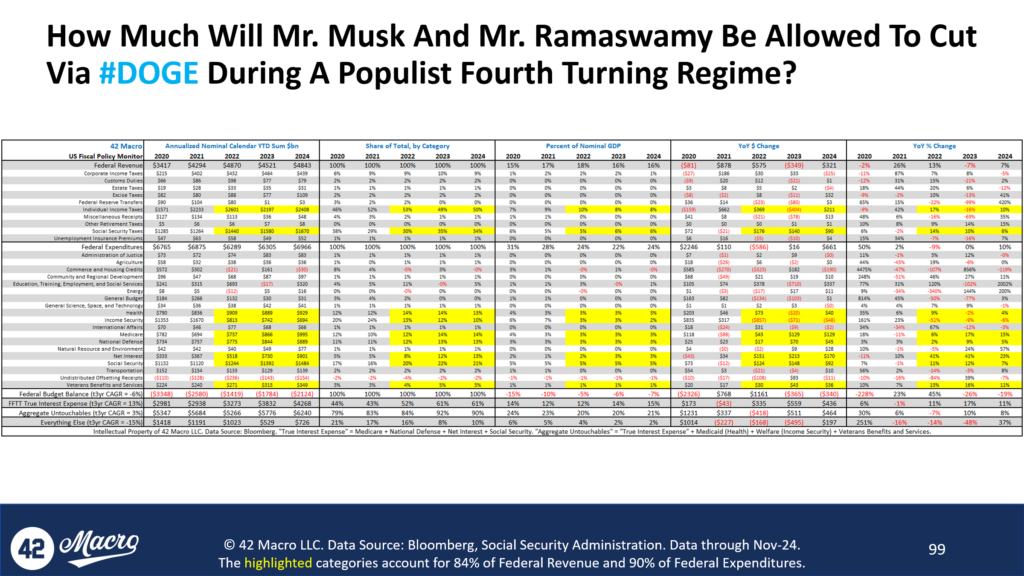
First, U.S. federal expenditures currently represent roughly a quarter of U.S. GDP—the highest share since at least 1970 excluding COVID and the GFC. Thus, significant cuts would likely catalyze a downturn in the economy—however beneficial a smaller government would be in the long run, which is something both Darius and Luke agree with. Per Luke, the last three recessions saw the U.S. federal budget deficit widen by 600bps, 800bps, and 1,200bps.
Secondly, our research indicates that approximately 90% of the budget is effectively untouchable. This “Aggregated Untouchables” category includes “True Interest Expense”—comprising Medicare, National Defense, Net Interest, and Social Security—along with Medicaid, Welfare, and Veterans’ Benefits. Collectively, these expenditures represent programs unlikely to face cuts under the current pro-populist political climate and are compounding at a rate of +3% per year (+13% per year in the “True Interest Expense” category). The remaining 10% of the budget, which largely includes discretionary spending, amounts to just over $700 billion and has already been shrinking at a compound rate of -15% per year over the past three years.
Lastly, demographic trends are exacerbating the fiscal burden. By 2025, 160,000 people will join the retirement-age population each month, compared to just 32,000 entering the working-age population.
Given these dynamics, meaningful deficit reduction appears improbable without tackling politically protected categories. This leads us to believe that meaningful austerity is an unlikely path forward in the context of this current Fourth Turning environment—especially without a significant devaluation of the US dollar preceding it.
Since our bullish pivot in November 2023, the QQQs have surged 42% and Bitcoin is up +190%.
If you have fallen victim to bear porn and missed part—or all—of this rally, it is time to explore how our KISS Model Portfolio or Discretionary Risk Management Overlay aka “Dr. Mo” will keep your portfolio on the right side of market risk going forward.
Thousands of investors around the world confidently make smarter investment decisions using our clear, accurate, and affordable signals—and as a result, they make more money.
If you are ready to learn more about how our clients incorporate macro into their investment process and how you can do the same, we invite you to watch our complimentary 3-part macro masterclass.
No catch, just high-quality insights to help you grow your portfolio—our way of saying thanks for being part of our global #Team42 community of thoughtful investors.
Why Tariffs Are Much Worse For Investors Than You Likely Realize
Darius recently sat down with Bleakley Financial Group CIO Peter Boockvar to discuss the impact of the Trump administration’s proposed tariffs, insights from the 42 Macro Positioning Model, and more.
If you missed the interview, here are the two most important takeaways from the conversation that have significant implications for your portfolio:
1. What Are The Second And Third Order Effects Of Tariffs And How Might They Cause Problems For Asset Markets?
According to data from the Committee for a Responsible Federal Budget, the Trump administration’s proposed tariffs are expected to generate nearly $3 trillion in revenue to help offset the ~$4+ trillion cost of permanently extending the Tax Cuts and Jobs Act (TCJA).
We believe the market is underestimating both the likelihood and scale of these tariffs given that the Congressional budget reconciliation process – specifically the Byrd Rule – will require pay fors to offset the lost revenue from tax cuts. An equally important but often overlooked factor is the potential for retaliation, particularly from China.
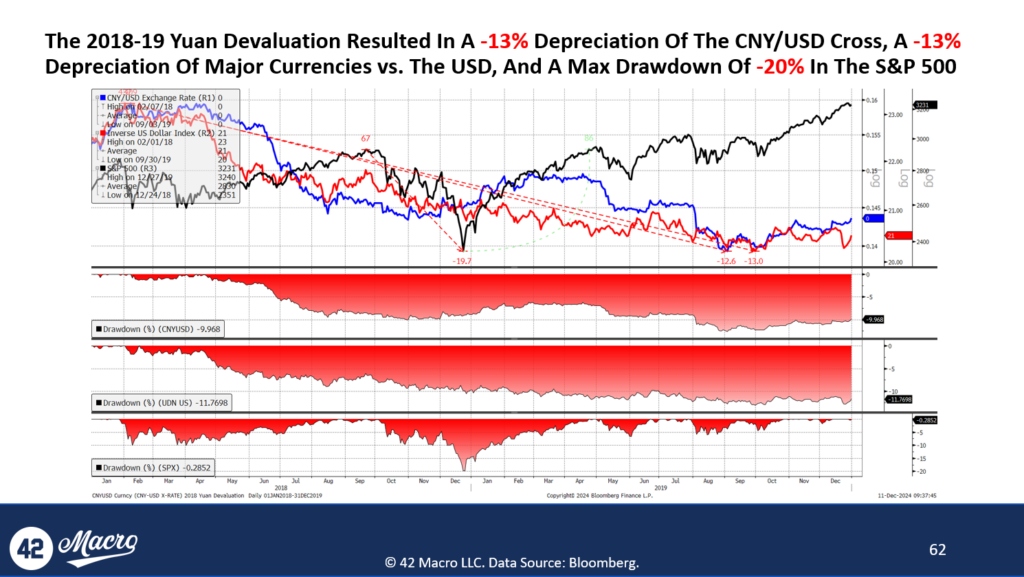
Historical examples, such as the Trump-era trade war, illustrate how heightened tariffs can lead to significant devaluations of the Chinese yuan. If this pattern repeats, it is likely to trigger competitive devaluations among other major currencies, resulting in an excessively strong U.S. dollar. In our view, such dollar strength is likely to suppress global capital formation and weigh heavily on U.S. corporate earnings, ultimately creating a significant headwind for asset markets.
2. What Insights Does The 42 Macro Positioning Model Provide About The Current State of Asset Markets?
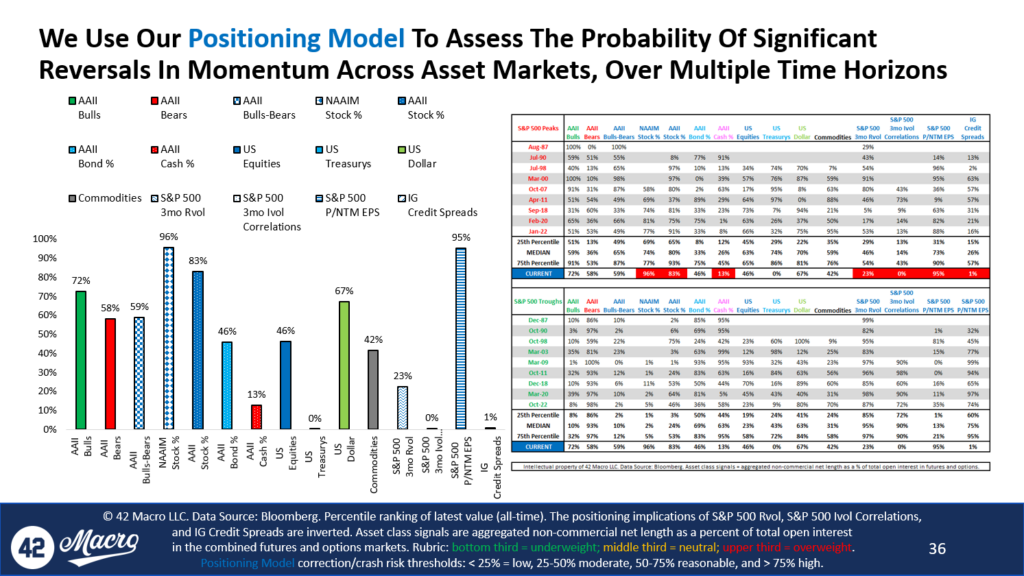
Our 42 Macro Positioning Model analyzes a 15 long-term time series, comparing their current levels to the median values observed at major bull market peaks and troughs. Currently, the model indicates several red flags for positioning and sentiment:
- AAII stock allocation exceeds the median value observed at major bull market peaks in the seven market cycles since Jan-98.
- AAII cash allocation is also below the median value observed at major bull market beaks.
- S&P 500 realized volatility—an inverse proxy for systematic fund exposure—is below the median value seen at prior bull market peaks.
- S&P 500 implied volatility correlations—an inverse proxy for market-neutral hedge fund exposure—is below the median value seen at prior bull market peaks.
- S&P 500 price/NTM EPS ratio sits in the 95th percentile of all historical data, dating back to the late 1980s, and is well above the median value observed at major bull market peaks.
- Investment-grade credit spreads are in the first percentile of all historical data, also dating back to the late 1980s, and are well below the median value observed at major bull market peaks.
From a positioning perspective, although these metrics do not necessarily serve as immediate catalysts for reversing the bullish momentum of risk assets, they represent significant potential energy once bearish catalysts emerge. When momentum does reverse, we believe positioning is asymmetric enough to unwind in an aggressive-enough manner to cause a stock market crash.
Since our bullish pivot in November 2023, the QQQs have surged 48% and Bitcoin is up +203%.
If you have fallen victim to bear porn and missed part—or all—of this rally, it is time to explore how our KISS Model Portfolio or Discretionary Risk Management Overlay aka “Dr. Mo” will keep your portfolio on the right side of market risk going forward.
Thousands of investors around the world confidently make smarter investment decisions using our clear, accurate, and affordable signals—and as a result, they make more money.
If you are ready to learn more about how our clients incorporate macro into their investment process and how you can do the same, we invite you to watch our complimentary 3-part macro masterclass.
No catch, just high-quality insights to help you grow your portfolio—our way of saying thanks for being part of our global #Team42 community of thoughtful investors.
What Are the Biggest Risks To Investors As This Fourth Turning Evolves?
Darius recently sat down with Michael Gayed from Lead-Lag Report to discuss how the 42 Macro Investment Process differs from other approaches, inflation, the likelihood of a meaningful federal budget deficit reduction under President Trump, and much more.
If you missed the interview, here are the three most important takeaways from the conversation that have significant implications for your portfolio:
1. How Does The 42 Macro Investment Process Differ From Other Traditional Approaches?
At 42 Macro, we take a fundamentally different approach to investment research and risk management.
While many investors rely on predictions, reacting only after those predictions are invalidated by subsequent macro or micro data, we utilize a Bayesian inference process that focuses on nowcasting evolving market conditions to inform our and our clients’ asset allocation and portfolio construction decision-making.
By embracing this Bayesian inference process, we deliver actionable insights that drive better outcomes for our clients. We believe that success in today’s market requires constant observation, adaptability, and the discipline to question assumptions. That is what we do at 42 Macro, and it is why thousands of investors worldwide achieve better investment outcomes with our proven risk management overlays (KISS and Dr. Mo).
2. Will The Fed Achieve Its Inflation Mandate Anytime Soon?
In short, no. We conducted a deep-dive empirical analysis of the business cycle, examining the median path of various indicators relative to recessions.
Our research indicates inflation is the most lagging indicator of the business cycle, historically breaking down durably below trend only four to five quarters after a recession begins.
Based on our deep understanding of how the business cycle works, we do not see a high probability of recession in the medium term. That implies inflation is unlikely to decline significantly from here and may even accelerate in the coming quarters.
3. How Likely Is Significant Federal Budget Deficit Reduction Under President Trump?
Our research indicates that key government spending areas—Medicare, National Defense, Net Interest, and Social Security—comprise 61% of total federal expenditures.
When including additional categories like Medicaid, Welfare, and Veterans’ Benefits—programs unlikely to face cuts under the current political climate—90% of the federal budget becomes effectively untouchable.
The remaining spending accounts for only approximately 10% of federal expenditures. Even if cut entirely, the deficit would still be -4% of GDP, making a balanced budget highly improbable without addressing politically untouchable categories. As a result, we believe a meaningful deficit reduction is unlikely under President Donald Trump – or any president for that matter in a Fourth Turning.
Since our bullish pivot in November 2023, the QQQs have surged 43%, and Bitcoin is up +176%.
If you have fallen victim to bear porn and missed part—or all—of this rally, it is time to explore how our KISS Model Portfolio or Discretionary Risk Management Overlay aka “Dr. Mo” will keep your portfolio on the right side of market risk going forward.
Thousands of investors around the world confidently make smarter investment decisions using our clear, accurate, and affordable signals—and as a result, they make more money.
If you are ready to learn more about how our clients incorporate macro into their investment process and how you can do the same, we invite you to watch our complimentary 3-part macro masterclass.
No catch, just high-quality insights to help you grow your portfolio—our way of saying thanks for being part of our global #Team42 community of thoughtful investors.
What Are The Hidden Dangers Looming Over Asset Markets?
Darius recently sat down with Anthony Pompliano to discuss the risks of a stronger US dollar, a potential global refinancing air pocket, and more.
If you missed the interview, here are the two most important takeaways from the conversation that have significant implications for your portfolio:
1. How Can A Stronger US Dollar Cause Problems For Asset Markets?
Our research indicates one significant implication of a strong US dollar is that it pressures foreign investors to repatriate dollar-denominated assets to service the 70% of global debt and 60% of cross-border lending that rely on the US dollar.
The events of 2022 provide a clear example of the potential consequences in such an environment. During a major US dollar rally from January to September of that year, the dollar appreciated by 18%, leading to a reduction in liquidity and severe declines across asset classes, as Gold fell 10%, US equities dropped 25%, US Treasury bonds declined 31%, and Bitcoin plummeted approximately 58%.
Moreover, tariff policies introduced by the Trump Administration, along with potential changes in the Treasury’s net financing policy, may accelerate dollar strength. Coupled with ongoing US economic exceptionalism—driven by tax cuts and deregulation—these factors could push the dollar even higher, increasing the pressure on markets and global financial stability.
If the Federal Reserve’s policy options are constrained by a resilient economy or persistent inflation, it may struggle to prevent the dollar from trending higher, creating significant challenges for asset markets.
2. Is A Global Refinancing Air Pocket On The Horizon?
At 42 Macro, we conducted a deep-dive empirical study on the global refinancing cycle and found it is, in fact, a key leading indicator of global liquidity.
By tracking the year-over-year growth rate of world total non-financial sector debt, lagged by four and a half years to align with typical refinancing timelines, we observe a strong correlation with fluctuations in global liquidity growth. Currently, the lagged growth rate of global non-financial sector debt is accelerating sharply, and our models project this trend to continue through late 2025.
While conventional wisdom suggests this is likely to catalyze an increase in global liquidity, the risk remains that liquidity may fail to expand meaningfully, thus creating a global refinancing air pocket, similar to the divergences observed in 2008-2009, 2011, 2015-2016, 2018-2019, and 2022. If global liquidity fails to follow the path of the year-over-year growth rate of world total non-financial sector debt, we believe it is likely to lead to severe disruptions—or even a meltdown—in global financial markets, negatively impacting asset markets along the way.
Since our bullish pivot in November 2023, the QQQs have surged 44% and Bitcoin is up +184%.
If you have fallen victim to bear porn and missed part—or all—of this rally, it is time to explore how our KISS Model Portfolio or Discretionary Risk Management Overlay aka “Dr. Mo” will keep your portfolio on the right side of market risk going forward.
Thousands of investors around the world confidently make smarter investment decisions using our clear, accurate, and affordable signals—and as a result, they make more money.
If you are ready to learn more about how our clients incorporate macro into their investment process and how you can do the same, we invite you to watch our complimentary 3-part macro masterclass.
No catch, just high-quality insights to help you grow your portfolio—our way of saying thanks for being part of our global #Team42 community of thoughtful investors.
Decoding The Macro Puzzle
Darius recently joined Sebastian Purcell on Real Vision to discuss how to utilize key economic cycles to anticipate Market Regime shifts, our “Resilient US Economy” theme, global liquidity, and much more.
If you missed the interview, here are the three most important takeaways from the conversation that have significant implications for your portfolio:
1. What Role Do Economic Cycles Play in Navigating Market Regimes?
At 42 Macro, we analyze six key economic cycles—growth, inflation, policy, corporate profits, liquidity, and positioning—to assess the sustainability of the current Market Regime and anticipate future shifts.
These cycles do not directly dictate our clients’ portfolio positioning, but they do provide context for how our core risk management signals – KISS and Dr. Mo – might evolve in the future.
By analyzing where we stand within each cycle, investors can assess the durability of the current Market Regime and prepare for potential changes across various time horizons.
2. How Does The US Economy’s Shrinking Reliance On The Manufacturing Sector Contribute To Our “Resilient US Economy” Theme?
One key pillar of our 28-month-old “Resilient US Economy” theme is the US economy’s limited reliance on the manufacturing sector, which has historically been the most cyclical part of the economy.
Manufacturing’s share of nominal GDP has declined from 28% in the 1950s to just 10% today. Furthermore, its share of total nonfarm payrolls has dropped from 44% in the 1940s to 14%.
Unlike manufacturing, the services sector—driven by population growth and migration—rarely contracts, providing stability and cushioning the economy from the sharp downturns often seen in manufacturing-led recessions.
The manufacturing sector has accounted for a median 98% of net job losses during postwar US recessions. Thus, limited exposure to the more-cyclical manufacturing sector equals limited risk of an economic downturn. It is not clear to us why so many investors failed to anticipate this obvious upside risk in the data.
3. What Is The Outlook For Global Liquidity?
At 42 Macro, we track global liquidity using our Global Liquidity Proxy, which aggregates global central bank balance sheets, global broad money supply, and global FX reserves (excluding gold). We then add a global bond market volatility overlay to simulate the impact of the expansion and contraction of the global repo market.
Our research also indicates there are leading indicators of global liquidity, such as equity and crypto market caps, US dollar, FX volatility, interest rates, fixed income volatility, and global growth, inflation, and employment.
Currently, our model analyzing those indicators indicates a modest increase in global liquidity over the medium term, suggesting the supportive backdrop for asset markets is likely to persist into early 2025.
Since our bullish pivot in November 2023, the QQQs have surged 43% and Bitcoin is up +175%.
If you have fallen victim to bear porn and missed part—or all—of this rally, it’s time to explore how our KISS Model Portfolio or Discretionary Risk Management Overlay aka “Dr. Mo” will keep your portfolio on the right side of market risk going forward.
Thousands of investors around the world confidently make smarter investment decisions using our clear, accurate, and affordable signals—and as a result, they make more money.
If you are ready to learn more about how our clients incorporate macro into their investment process and how you can do the same, we invite you to watch our complimentary 3-part macro masterclass. No catch, just high-quality insights to help you grow your portfolio—our way of saying thanks for being part of our global #Team42 community of thoughtful investors.
Is The Fed On The Precipice Of Another Major Policy Mistake?
Darius recently hosted Unlimited Funds CEO Bob Elliot on this month’s 42 Macro Pro to Pro, where they unpacked the Fed’s asymmetrically dovish reaction function, the impact of the work-from-home phenomenon, their systematic approaches to investing, and more.
If you missed the interview, here are the three most important takeaways from the conversation that have significant implications for your portfolio:
1. What Is Driving the Fed’s Expansionary Monetary Policy?
We authored our “Resilient U.S. Economy” theme in September 2022, and since then, we have identified a new contributing pillar: the continuation of expansionary monetary policy.
We believe this policy direction is puzzling, driven largely by the Fed’s belief that no further cooling in the labor market is needed to achieve 2% inflation—a stance we view as highly likely to be inaccurate. Nevertheless, it remains the Fed’s current perspective.
Bob Elliot offered an insightful take on this issue, suggesting that the Fed’s position likely stems from a fundamental disconnect between how academics interpret markets and models versus how practitioners do. This divergence may explain their controversial outlook on the labor market’s role in achieving their desired inflation target.
2. How Is The Work-From-Home Phenomenon Affecting Labor Market Dynamics?
At 42 Macro, we monitor various workforce dynamics metrics, including Nonfarm Productivity Growth and the Private Sector Quits Rate. Our analysis shows that Productivity Growth is currently above trend, while the Private-Sector Quits Rate has declined significantly from its elevated levels over the past couple of years.
We believe this shift toward longer employee tenures is likely a key driver behind the current above-trend rate of productivity growth, as longer retention generally leads to greater employee efficiency. This increased productivity is helping to offset some of the inflationary pressures stemming from higher wages and income growth, and we believe it is likely to persist.
Additionally, the rise of remote work plays a significant role in this dynamic. With the flexibility to live and work from virtually anywhere, employees are more likely to stay with their current employers, further contributing to lower turnover and increased productivity.
3. Why Did We Replace Core Fixed-Income Exposure with Gold in Our KISS Portfolio?
One of the recent adjustments we made in our systematic KISS Model Portfolio was to replace our core fixed-income exposure with gold. This decision reflects our understanding that if our Investing During A Fourth Turning Regime analysis proves true over the long term, it is highly unlikely that bonds will outperform other assets on a real, risk-adjusted basis.
While we recognize that no one—including us—is ever 100% correct on their fundamental views, even partial accuracy in our predictions suggests a strong likelihood that assets like gold, Bitcoin, stocks, and real estate will prove to be far better hedges against accelerated monetary debasement and financial repression than bonds. Indeed, we expect monetary debasement and financial repression to be tools that the Fed employs to address the challenges of excessive sovereign debt and a robust economy that leaves little incentive for buyers of government bonds.
Given this dynamic, we pivoted entirely out of core fixed-income exposure and allocated that portion of our systematic KISS Model Portfolio to gold in October. Our 60/30/10 trend-following strategy now features maximum allocations of 60% stocks, 30% gold, and 10% Bitcoin.
Since our bullish pivot in November 2023, the QQQs have surged 37%. Momentum $MTUM is up +48% and Bitcoin is up +169%.
If you have fallen victim to bear porn and missed part—or all—of this rally, it’s time to explore how our KISS Model Portfolio or Discretionary Risk Management Overlay aka “Dr. Mo” will keep your portfolio on the right side of market risk going forward.
Thousands of investors around the world confidently make smarter investment decisions using our clear, accurate, and affordable signals—and as a result, they make more money.
If you are ready to learn more about how our clients incorporate macro into their investment process and how you can do the same, we invite you to watch our complimentary 3-part macro masterclass.
No catch, just macro insights to help you grow your portfolio—our way of saying thanks for being part of our global #Team42 community of thoughtful investors.
Buying The Dip In A Risk On Market
Darius sat down with Schwab Network’s Nicole Petallides last week to discuss the current risk-on Market Regime and the outlook for asset markets.
If you missed the interview, here is the most important takeaway from the conversation that has significant implications for your portfolio:
We Are In A Risk-On Market Regime And Believe Investors Should Consider Buying This Dip For Three Reasons:
- U.S. growth is likely to exceed consensus expectations over the medium term, alongside an improving global economy.
- The Federal Reserve maintains an asymmetrically dovish reaction function, which we believe will continue to support asset markets over the medium term.
- U.S. and global liquidity are likely to accelerate markedly over the medium term.
Despite our being in a risk-on Market Regime, our positioning model recently indicated a high risk of a correction in risk assets, and we believe the current decline in stocks is likely the beginning of that correction.
We do not expect this correction to be severe, likely no more than 5-8% in $SPX price terms. The earliest we currently anticipate a sustained risk-off market regime commencing is Q2 of next year.
By now, you’ve likely realized that piecing together an investment strategy from finance podcasts, YouTube videos, and macro “gurus” on 𝕏 is not delivering the results you know you deserve.
This kind of approach only leads to confusion from conflicting advice, frustration from mediocre returns, and exhaustion from the emotional rollercoaster of your portfolio swings.
If you don’t change your process, how can you expect to get better results?
Over 2,000 investors around the world confidently make smarter investment decisions using our clear, actionable, and accurate signals—and as a result, they make more money.
If you are ready to learn more about how our clients incorporate macro into their investment process and how you can do the same, we invite you to watch our complimentary 3-part macro masterclass.
No catch, just macro insights to help you grow your portfolio—our way of saying thanks for being part of the 42 Macro universe.
Financial Repression Survival Tactics
Darius recently sat down with Exploring Prosperity’s Robert Dewey, where they discussed the new wave of populism, the impacts of the U.S. regional banking crisis, the U.S. dollar, and more.
If you missed the interview, here are the three most important takeaways from the conversation that have significant implications for your portfolio:
1. Is There A Material Difference Between Either Presidential Candidate From A Fiscal Policy Perspective?
Regardless of which candidate wins the upcoming election, we believe we are likely to see even more populism, or the promotion of policies that reflect the concerns of the people, regardless of the economic or institutional impact those policies have.
No matter what form this new wave of populism takes, it is likely to drive US public sector debt growth that forces the Fed to remain asymmetrically dovish.
Our view is that we are all frogs being slowly boiled alive in a pot of monetary debasement and financial repression, driven by Fourth Turning-style fiscal dominance. We have called for continued financial repression, which we have already experienced—and in our view, it is likely to accelerate throughout this Fourth Turning.
2. How Has The Focus of Policymakers Shifted Since The U.S. Regional Banking Crisis?
During the U.S. regional banking crisis in March 2023, the forward rate curve inverted and has remained persistently negative ever since.
This deepening inversion signaled to investors that financial stability concerns had taken precedence—reflecting Fourth Turning-style financial repression, in which stabilizing sovereign debt markets is the central focus for policymakers.
The persistent inversion has profoundly impacted the Fed’s balance sheet and overall U.S. liquidity. As the Fed responded with dovish measures during the crisis, trillions of dollars flowed out of the reverse repo (RRP) facility and into financial markets. In our view, this liquidity flow remains ongoing and is likely to extend into Q1 2025.
3. How Will Global Reliance on The US Dollar Change Over The Next Decade?
Our research indicates the U.S. dollar currently plays a dominant role in the global financial system:
- 50% of currencies with pegs are anchored to the dollar (by GDP).
- 60% of global FX reserves are held in dollars.
- 60% of cross-border bank lending is conducted in dollars.
- 70% of international debt securities are dollar-denominated.
- 79% of global trade is invoiced in dollars.
- 88% of foreign exchange transactions involve the dollar.
- 99% of stablecoin reserves are backed by the dollar.
In our view, these numbers will decline over the long term as countries reduce their reliance on the dollar. We believe the continuation of aggressive populist fiscal policies in the U.S. poses significant risks for investors, with the most important risk being how the Federal Reserve responds to the global shift away from the dollar, as this transition will have profound implications for financial markets. We think the Fed will print money to monetize US deficits, filling the increasing void left behind by international investors and central banks.
By now, you’ve likely realized that piecing together an investment strategy from finance podcasts, YouTube videos, and macro “gurus” on 𝕏 is not delivering the results you know you deserve.
This kind of approach only leads to confusion from conflicting advice, frustration from mediocre returns, and exhaustion from the emotional rollercoaster of your portfolio swings.
If you don’t change your process, how can you expect to get better results?
Over 2,000 investors around the world confidently make smarter investment decisions using our clear, actionable, and accurate signals—and as a result, they make more money.
If you are ready to learn more about how our clients incorporate macro into their investment process and how you can do the same, we invite you to watch our complimentary 3-part macro masterclass.
No catch, just macro insights to help you grow your portfolio—our way of saying thanks for being part of the 42 Macro universe.
Navigating Inflation, Budget Deficits, and Global Monetary Shifts
Darius recently hosted our friend Nadine Terman on 42 Macro’s Pro to Pro, where they discussed inflation, the federal budget deficit, China, and more.
If you missed the interview, here are the three most important takeaways from the conversation that have significant implications for your portfolio:
1. Are Both Political Parties Likely to Increase The Federal Budget Deficit?
Even if Republicans win and Elon Musk advocates for severe spending cuts, we believe those cuts are unlikely to materialize. While there may be headlines about cutting spending, slashing large portions of the budget carries significant career risk.
Our research shows that the type of wasteful spending Musk might target accounts for less than 1% of federal expenditures. Meaningful cuts would require reductions in defense, Medicare, or Medicaid—areas deeply important to American voters.
Some minor budget trims may occur, but both parties appear committed to profligate spending, with no clear plan to meaningfully reduce the national debt.
2. How Has The Recent Shift In U.S. Monetary Policy Affected Chinese Policymakers?
At 42 Macro, we monitor the growth of the PBOC’s balance sheet relative to the share allocated to FX reserves. When the yuan appreciated sharply in early 2015, its real effective exchange rate (REER) rose significantly, disrupting China’s export model.
As the Yuan became expensive on a REER basis, export growth secularly slowed and foreign direct investment into China slowed, reducing the expansion of its manufacturing base. As a result, the share of FX reserves declined from approximately 83% to just 50% since March 2014.
However, the recent shift to a more neutral U.S. monetary policy, evidenced by the Fed’s decision to implement a 50-basis-point rate cut, suggests less risk of severe yuan devaluation. This change has signaled to Chinese policymakers that they can now begin accelerating monetary expansion.
By now, you’ve likely realized that piecing together an investment strategy from finance podcasts, YouTube videos, and macro “gurus” on 𝕏 is not delivering the results you know you deserve.
This kind of approach only leads to confusion from conflicting advice, frustration from mediocre returns, and exhaustion from the emotional rollercoaster of your portfolio swings.
If you don’t change your process, how can you expect to get better results?
Over 2,000 investors around the world confidently make smarter investment decisions using our clear, actionable, and accurate signals—and as a result, they make more money.
If you are ready to learn more about how our clients incorporate macro into their investment process and how you can do the same, we invite you to watch our complimentary 3-part macro masterclass.
No catch, just macro insights to help you grow your portfolio—our way of saying thanks for being part of the 42 Macro universe.
Why Listening to The Market Beats Macro Predictions Every Time
Darius recently sat down with our friend Jason Shapiro from Crowded Market Report, where they discussed how to effectively use macro, the 42 Macro investment process, the outlook for China, and more.
If you missed the interview, here are the three most important takeaways from the conversation that have significant implications for your portfolio:
1. What Is The Optimal Way to Incorporate Macro Into An Investment Strategy?
We would argue that many investors incorrectly incorporate macro into their investment strategy because they are not paying enough attention to what the market is signaling.
One of the most advanced tools we have developed for our clients is our Global Macro Matrix, which allows us to nowcast the current Market Regime and analyze what the market is signaling at any given moment. The tool also allows us to spot durable inflections in asset market momentum in real-time, thus providing 42 Macro clients the best chance to remain on the right side of market risk.
This insight is crucial because the Market Regime dictates dispersion within and across asset classes, ultimately shaping the returns we all experience as investors. By following what the market tells us, we can help our clients align their portfolios with what the market is actually trying to price in, not with what they hope it prices in. Note the difference.
2. What Proven Quantitative Techniques Influence The 42 Macro Process?
At 42 Macro, we stand on the shoulders of giants who came before us. Our research incorporates strategies that have stood the test of time on global Wall Street:
- Regime Segmentation – Introduced by Ray Dalio in the 1970s
- Bayesian Inference – Applied to Wall Street by Daniel Kahneman and Amos Tversky in the early 2000s
- Volatility as a Leading Indicator for Price – Pioneered by Benoit Mandelbrot in the late 70s and early 80s
Our investment approach leverages these proven quantitative techniques, allowing us to deliver superior outcomes that meet our clients’ needs more effectively than alternative strategies.
3. What Is The Outlook For China?
We believe China is either in or sliding into a balance sheet recession, forcing Beijing to ease monetary and fiscal policy aggressively. Here are the three core factors behind this view:
- Excessive Debt: Private non-financial sector debt in China stands at 205% of GDP—similar to Japan’s overly indebted level prior to its balance sheet recession, which remains the clearest example outside of the post-GFC U.S. economy.
- Poor Capital Allocation: China’s investment-to-GDP ratio is 42%, far surpassing Japan’s peak before its real estate bubble burst. A similar bubble has plagued China for the past ~15 years.
- Shrinking Labor Force: China’s old-age dependency ratio is rising faster than in most countries, leading to two critical challenges—a shrinking labor force and an aging population.
While we remain cautious about China’s long-term outlook due to these structural issues, we do expect positive returns from Chinese assets in response to ongoing policy support. However, we do not recommend staying indefinitely long.
Instead, we advise aligning your China exposure with our Discretionary Risk Management Overlay, aka “Dr. Mo,” which pivoted clients into a max position in China on September 17th. Since then, the FXI ETF—a proxy for Chinese stocks—has rallied about 24%, even factoring in the recent pullback. At some point, Dr. Mo will instruct 42 Macro clients to book gains in China. To date, it has not yet done so.
By now, you’ve likely realized that piecing together an investment strategy from finance podcasts, YouTube videos, and macro “gurus” on 𝕏 is not delivering the results you know you deserve.
This kind of approach only leads to confusion from conflicting advice, frustration from mediocre returns, and exhaustion from the emotional rollercoaster of your portfolio swings.
If you don’t change your process, how can you expect to get better results?
Over 2,000 investors around the world confidently make smarter investment decisions using our clear, actionable, and accurate signals—and as a result, they make more money.
If you are ready to learn more about how our clients incorporate macro into their investment process and how you can do the same, we invite you to watch our complimentary 3-part macro masterclass.
No catch, just macro insights to help you grow your portfolio—our way of saying thanks for being part of the 42 Macro universe.